


Reading a book is usually treated as a linear process. You start at page 1 and go to the end. The physical form of a book—a stack of bound pages—suggests this is the right way to consume it.
But if you look at how people actually learn, it is almost never linear.
Learning is more like exploring a city. You don't just walk down one street from beginning to end. You wander. You find a central square, and from there you explore the side streets.
Most readers treat a book like a train track. They get on at the start and wait to be delivered to the finish. But the best readers—the ones who actually master a subject—treat a book like a landscape. They look for the peaks.
The problem with the train track approach is that it assumes every page is equally important. It isn't. In almost any non-fiction book, there are a few core ideas that do most of the work. If you understand those, the rest follows.
This brings us to a new problem we're seeing right now: citations.
AI tools are getting very good at providing page-level citations. If you ask a question, you get an answer with a little footnote pointing to a specific sentence on page 42.
This is great for research. It's great for fact-checking. But it is terrible for learning.
When you pull a single sentence out of a book to prove a point, you strip away the context. You ignore the author's broader argument. Research is about finding facts. Mastery is about understanding the structure of an argument.
This is why we built the Reading Path.
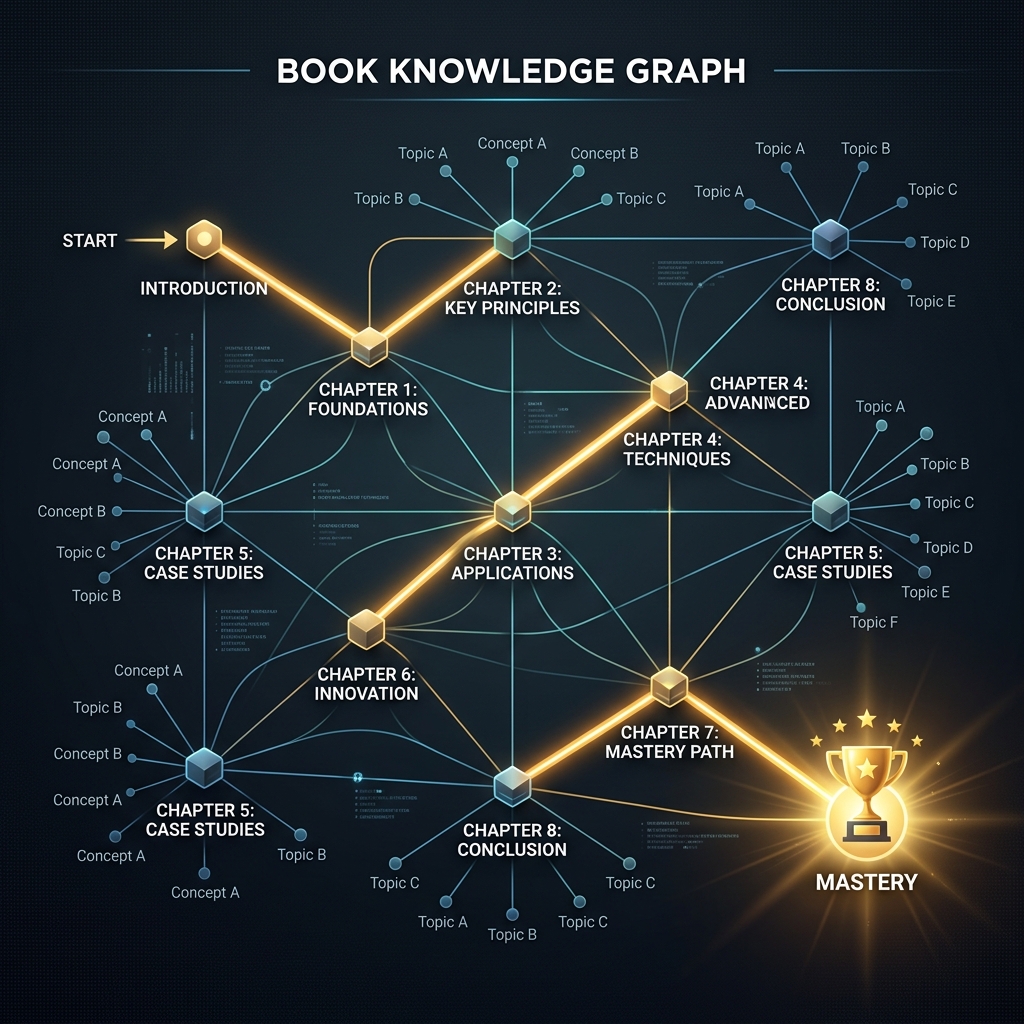
Instead of just citing a specific page, iChatbook provides a dynamic list of source chapters directly within the chat for every response.
We don't just give you the answer. We show you the structural foundation of how that answer was constructed. It says: "To understand this, look at Chapter 3 for the foundation, see how it’s applied in Chapter 7, and check Chapter 12 for the implications."
Knowing that "A" and "B" are true is one thing. Understanding why "A" leads to "B" is what we call mastery. By referencing the original chapters rather than isolated snippets, you can see how ideas connect and build upon one another.
We live in an era of information abundance but insight scarcity. It's easier than ever to find facts, but harder than ever to build a deep understanding. The bottleneck is no longer access to information; it's the cognitive bandwidth required to process it.
The Reading Path expands that bandwidth. It reduces the friction of learning by letting you focus your attention where it matters most: the architecture of the idea.