The Idea Graph maps concepts across books, authors, and community content — showing you where ideas reinforce, contradict, or extend each other.
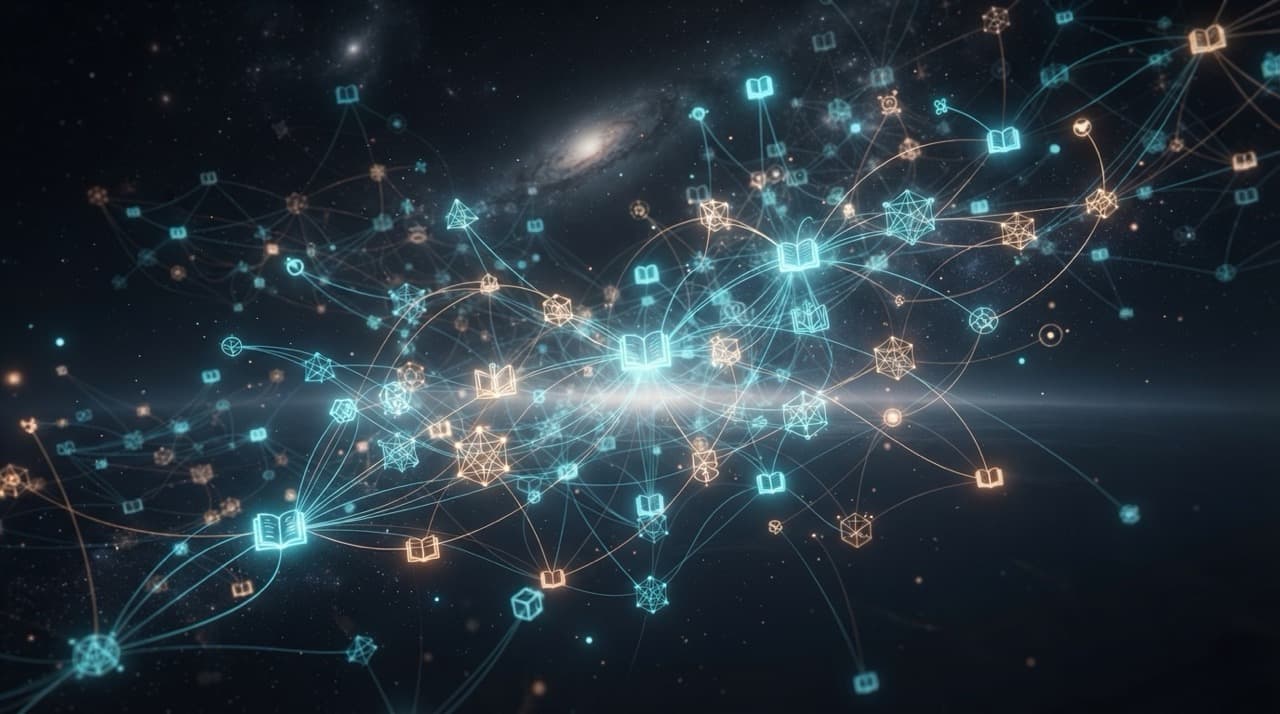
Two books might make the same point with different language, or directly contradict each other — and you'd never know unless you read both. The connections between ideas are invisible when you read one book at a time.
Every book you read adds nodes and connections to your understanding.
Books, chapters, and concepts all become nodes in the graph. Each one connects to related ideas across your entire library, creating a web of knowledge.
AI analyzes every piece of content and automatically links related concepts — even when authors use completely different terminology to describe the same idea.
The graph spans everything — bestselling books, your community's original work, and your personal library. Ideas connect regardless of source.
Discover that a psychology book and a business book are making the same argument from different angles. The graph reveals patterns human memory misses.
Click a book, a chapter, or a concept. The graph centers on your starting point and radiates outward to show connections.
See related ideas from across the library. Follow threads through different books and authors. Each click reveals new territory.
Click any node to read the summary, chat with the source, or add it to a collection. The graph is your launching pad for deep exploration.
A living network of ideas that grows with every book you read.
● "Atomic Habits" (James Clear)
├── Identity-based change ──── ● "Mindset" (Carol Dweck)
├── Compound growth ──────── ● "The Compound Effect" (Darren Hardy)
├── Environment design ────── ● "Nudge" (Thaler & Sunstein)
│ └── ● Pastor Mike's "Creating Space for Change"
└── Habit stacking ────────── ● "Deep Work" (Cal Newport)
● "Deep Work" (Cal Newport)
├── Flow states ─────────── ● "Flow" (Mihaly Csikszentmihalyi)
├── Attention economy ───── ● "Stolen Focus" (Johann Hari)
└── Deliberate practice ──── ● "Peak" (Anders Ericsson)
Anyone who reads across multiple sources and wants to see the big picture.
Find related work across disciplines. See how your thesis connects to existing literature automatically.
Connect ideas across your curriculum. See how this week's reading builds on last semester's foundations.
Map your field's landscape. Understand where thought leaders agree, disagree, and where the gaps are.
Follow threads wherever they lead. Let the graph suggest your next read based on what you've already explored.
Yes. When a book is processed, AI analyzes its concepts and automatically maps connections to everything else in the library. No manual tagging required.
Coming soon. We're building the ability for users to add manual links between ideas, annotate connections, and flag relationships the AI might have missed.
Yes. The Idea Graph spans everything — published books from the catalog and original works created by your community members. Ideas connect regardless of their source.
Each connection is generated with a confidence score. High- confidence links are shown prominently; lower-confidence ones appear as suggested connections you can verify or dismiss.
Start exploring. Every book you add makes the graph richer and the connections deeper.
Explore the Idea Graph
