ChatGPT is unmatched at coding, writing emails, and answering general questions. But it has no library, no book-native chapter structure, and no retention layer. iChatbook is a purpose-built ChatGPT alternative for books, designed for speed (summaries), active retention, and multi-book synthesis.
“What's the question I should be asking you? Which book should I be reading, and then can you make that book for me? Make it 20 pages. I like it in this particular style because it's my favorite style of author. And then I want to download it as an MP3 file and listen to it on my way to work. I have 43 minutes.”
“You want a book? Tell the AI what kind of book you want. I want this, I want it to be set in London, and I want these protagonists. Can you make it like that?”
Two billionaires describing a workflow millions of people are already trying inside ChatGPT. It works — until it doesn't.
And where each step quietly fails you.
“What book should I read?”
Recommends based on vibes and bestseller lists — not your actual situation, reading history, or the problems you're solving. Same suggestions you'd get from a Google search.
“Summarize that book for me.”
ChatGPT hasn't read the book. It reconstructs from reviews, blurbs, and web fragments. Specific research gets hallucinated. Nuanced arguments get flattened. You're reading a plausible-sounding fabrication.
“Make it 20 pages in Gladwell's style.”
The style is surface-level mimicry. The content is still the hallucinated summary — now dressed up in better prose. You're polishing fiction, not knowledge.
Everything Bartlett described — built as a real system, grounded in actual book text.
| Bartlett's wish | iChatbook today |
|---|---|
| “AI knows what I'm dealing with” | Your reading history, notes, and chat context build a profile that improves recommendations over time |
| “Which book should I be reading?” | 200,000+ book library with personalized recommendations based on your shelf and reading patterns |
| “Make that book for me” | 4-depth summaries (Brief → Standard → Detailed → Analysis) generated from actual book text via RAG — not hallucinated from training data |
| “Make it 20 pages” | Choose your depth: Brief (5 min), Standard (15 min), Detailed (30 min), or full Analysis notes |
| “In my favorite author's style” | Coming soon — style-adapted summaries |
| “Download as MP3” | 7 audio formats: Deep Dive, Brief Overview, Critique, Debate, Story Salon, Author's Commentary. Real MP3 files — download and go. |
| “I have 43 minutes” | Format selection controls length — Brief Overview ≈ 3 min, Deep Dive ≈ 20–40 min, full chapter audio matches your commute |
| “Huge memory on me” | Persistent library, Idea Graph connecting concepts across books, notes that compound over months and years |
ChatGPT's training data includes book metadata — titles, authors, reviews, Wikipedia summaries, and fragments that appeared on the open web. It does not contain the full text of most published books.
When you ask ChatGPT to “make Thinking, Fast and Slow for me in 20 pages,” it generates a plausible reconstruction. It knows System 1 and System 2 exist. It knows the book discusses cognitive biases.
But it invents specific experiments, flattens nuanced arguments, and omits the qualifications Kahneman actually made. You're not learning from the book — you're learning from a hallucination of the book.
iChatbook's approach
Our summaries are generated from actual indexed text — chapter by chapter, with citations back to the source material. When we say “Chapter 4 discusses the anchoring effect,” it's because we processed Chapter 4. Not because we guessed.
The Honest Comparison
ChatGPT is the better choice if you need a versatile general-purpose assistant for coding, emails, or ad-hoc questions. It's brilliant at what it does — but it's built for general Q&A, not for learning from books.
iChatbook is the better choice if your goal is to discover, read, and actually learn from books. It has no library, no chapter structure, and no retention tools. iChatbook is built for knowledge seekers: a pre-indexed library of thousands of books, chapter-by-chapter understanding, and tools that make knowledge stick.
In one line: ChatGPT is a brilliant general assistant. iChatbook is a knowledge discovery engine.
How iChatbook and ChatGPT stack up when it comes to reading and learning.
| Feature | iChatbook | ChatGPT |
|---|---|---|
| Pre-indexed universal library | ||
| Structured chapter-by-chapter understanding | ||
| Interactive quizzes to test retention | ||
| ChatGPT | iChatbook | |
|---|---|---|
| Getting started | Blank box. You find and paste content. | a pre-indexed library of thousands of books, pre-indexed and ready. Nothing to upload. |
| Purpose | General-purpose Q&A (coding, writing, etc.) | Discover and learn from books |
| Structure | Unstructured conversation | Chapter by chapter — the way a reader moves through a book |
| Retention | Each conversation in isolation | Quizzes, Idea Graph, study tools — built to make knowledge stick |
ChatGPT is excellent at answering questions. iChatbook is built for knowledge seekers.
a pre-indexed library of thousands of books, instantly. No uploading, no pasting. Just log in and discover books you didn't even know to look for.
A Collection isn't a folder of uploads — it's a curriculum you can talk to. Group books by theme and chat across all of them at once.
Summaries are disposable. The Idea Graph is something you keep building — a persistent knowledge map that grows with every book.
It doesn't just answer you — it makes sure you actually learned it. Discover, read, engage, and be tested.
ChatGPT is a general-purpose AI. While it can give you a high-level summary of a book, it lacks structure. iChatbook is a dedicated knowledge discovery engine that breaks books down chapter by chapter, tests your understanding with quizzes, maps out an idea graph, and helps you retain what you learn in a persistent library.
Not natively. ChatGPT treats each conversation in isolation. iChatbook is built around retention, offering study tools, quizzes, and an idea graph to help knowledge stick long after you finish reading.
You can upload a document to ChatGPT, but it will treat it as a generic file to search. iChatbook already has a pre-indexed library of thousands of books ready to go with no uploads required, and it processes them specifically to extract chapter structures, concepts, and frameworks.
If your goal is to read, understand, and retain knowledge from books, iChatbook is the better choice. For coding, writing emails, or general queries, ChatGPT is brilliant at what it does. They serve different jobs.
Deep dives into how ChatGPT handles specific book tasks — and where it falls short.
a pre-indexed library of thousands of books, ready the moment you log in. Nothing to upload. Explore, synthesize, and retain knowledge across the world's most important texts.
No credit card required • Free to start • Instant access
“Download it as an MP3.”
Advanced Voice Mode reads text aloud — but there's no downloadable MP3 file. No offline playback. No podcast format. You're stuck in the chat window.
“I want to reference this later.”
Good luck finding it in 3 months. No library. No persistent notes. No cross-book connections. Every conversation is an island — nothing compounds.
ChatGPT is the prototype. iChatbook is the production version.
| Visual idea & knowledge graphs |
| Persistent library for saving notes |
| Multiple AI model families (GPT, Gemini, Claude, etc.) |
| General-purpose tasks (coding, emails) |
| Audiobook / text-to-speech support |
| Free to start |
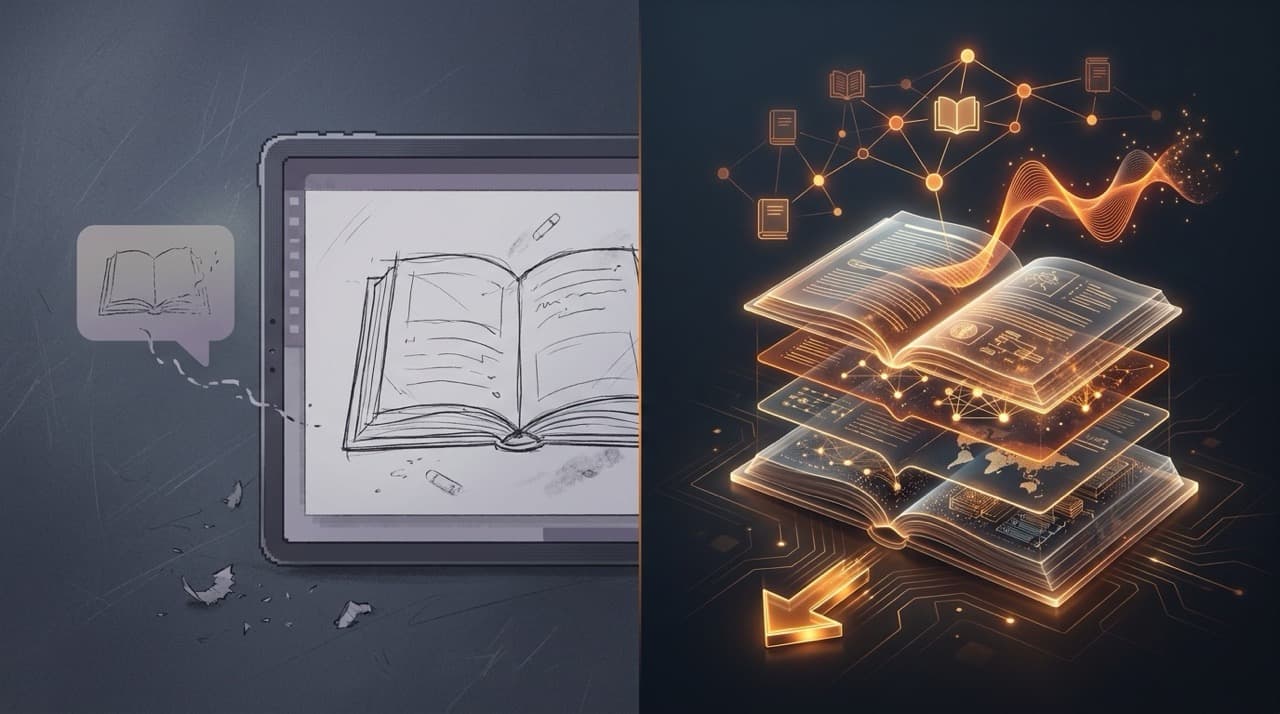
Dictate an idea, get a book back. Where ChatGPT’s version breaks down.

